Diesel Storage & Transfer Contamination: Why Cleanliness Standards Fall Short
In refinery dispatch, tank farm storage, industrial fuel supply, and generator backup power applications, diesel cleanliness directly determines downstream equipment reliability. However, from refinery unit to terminal tank, diesel undergoes at least 3–5 transfers and storage cycles, each presenting a new contamination opportunity.
Common diesel contaminants fall into three categories:
1. Solid Particulates — Oxidized iron scale from pipeline corrosion, peeling paint and sediment from tank inner walls, and bottom sludge from transport tankers. These particles range from tens of microns to sub-micron sizes, with 5–20 μm particles posing the greatest risk to high-pressure common-rail fuel injectors (HPCR).
2. Free Water — Diesel inevitably contacts trace moisture during transport and storage. Free water not only accelerates corrosion of metal components but also provides a breeding ground for microorganisms, leading to biological diesel degradation and increased acid number. National standards require free water content ≤ 500 ppm, while high-end industrial applications (such as data center backup power) typically demand ≤ 50 ppm.
3. Microbial Contamination — When free water and suitable temperatures coexist, microorganisms in diesel (such as *Hormoconis resinae*) multiply rapidly, forming biofilms that clog filters and fuel lines, producing organic acids that corrode tanks and piping. This is the largest hidden threat to long-term diesel storage.
Diesel Contaminant Sources and Typical Hazards
| Contaminant Type | Primary Source | Typical Size/Concentration | Impact on Equipment |
|---|---|---|---|
| Iron Oxide Rust | Aged pipelines, tank inner walls | 5–100 μm | Injector wear, fuel line blockage |
| Sediment/Sludge | Tank bottom deposits, transport residue | 20–500 μm | Filter clogging, tank contamination |
| Free Water | Condensation, seal failure | 100–5000 ppm | Metal corrosion, microbial growth promotion |
| Microbes/Biofilm | Moisture + suitable temperature environment | Colloidal grade | Filter screen blockage, acid-induced corrosion |
| Paint/Coating Debris | Tank inner wall peeling | 50–200 μm | Precision filter blockage |
From refinery dispatch to terminal equipment tank, Jingyuan diesel purification systems provide filtration protection at every critical node
Hidden Costs of Conventional Cartridge Solutions: Why 3-Year TCO Is Not Low
Most tank farms and industrial users currently rely on disposable cartridges (such as glass fiber, melt-blown PP, or stainless steel mesh pleated cartridges) as the primary means of diesel purification. Cartridge solutions feature low initial investment and simple installation, but expose multiple long-term cost traps in actual operation.
Consumable Cost Accumulation — Taking a medium-sized tank farm as an example, a single loading filter requires 2–4 cartridge replacements per month, with annual consumable costs of RMB 30,000–80,000. Three-year cumulative consumable costs typically exceed equipment cost by 2–3 times.
Downtime Loss Cannot Be Ignored — Each cartridge replacement requires 30–120 minutes of shutdown, directly impacting loading efficiency during peak tank farm periods. For 24-hour continuous industrial fuel supply systems, shutdown means production line stoppage.
Filtration Performance Degradation — As cartridge dust-holding capacity increases, filtration differential pressure continuously rises and flow rate gradually declines. When differential pressure reaches threshold, replacement is mandatory; otherwise 'unloading effect' occurs (pressure fluctuations cause previously trapped particles to re-penetrate), exacerbating downstream contamination.
Solid Waste Disposal Pressure — Used cartridges are classified as oil-containing hazardous waste, requiring HW08-category treatment at RMB 3,000–8,000 per ton. As environmental regulations tighten, disposal channels are increasingly restricted.
Rigid Composite Membrane Technology: From 'Consumable Filtration' to 'Regenerative Filtration'
Jingyuan CIS high-polymer rigid composite membrane technology fundamentally changes the underlying logic of diesel filtration. Unlike cartridges that rely on physical interception and periodic replacement, rigid membranes employ self-supporting rigid pore-wall structures, achieving depth filtration through precisely controlled asymmetric gradient micropores while utilizing gas-pulse regeneration for self-recovery of the filter media.
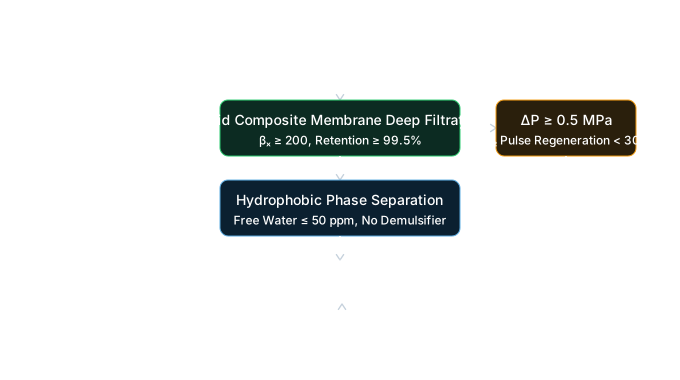
βₓ ≥ 200 Filtration Ratio — Jingyuan rigid membranes achieve an high-efficiency capture ratio βₓ ≥ 200 (ISO 16889), meaning only 1 out of every 200 particles larger than the rated pore size can penetrate, i.e., single-pass retention efficiency ≥ 99.5%. This far exceeds ordinary cartridge levels of β₁₀ = 2–20.
Gas-Pulse Regeneration — When trans-membrane differential pressure reaches the 0.5 MPa threshold, the system automatically triggers N₂ pressurization → pulse release, with the entire process completing in 5-15 min safety pause with brief 5-15 min safety pause. Post-regeneration flux recovery ≥ 90%, with single N₂ consumption ≤ 0.5 kg.
Hydrophobic Phase Separation — The membrane surface undergoes oleophilic-hydrophobic modification, physically repelling water molecule coalescence. Without demulsifiers or coalescing cartridges, free water is stably controlled at ≤ 50 ppm, even effective in high-temperature biodiesel (B50).
≥ 3-Year Service Life — Rigid membrane elements feature a non-consumable structure, with service life ≥ 3 years under normal operating conditions. Upon expiration, only the membrane element module needs replacement, not the entire machine, significantly reducing maintenance costs.
3-Year Total Cost of Ownership Comparison: Rigid Membrane vs. Disposable Cartridge
| Cost Item | Disposable Cartridge Solution | Jingyuan Rigid Membrane Solution |
|---|---|---|
| Initial Equipment Investment | RMB 80,000–150,000/unit | RMB 250,000–400,000/unit |
| 3-Year Consumable Cost | RMB 90,000–240,000 | ≈ 0 (no consumables) |
| Downtime Maintenance Loss | 18–72 hours/year | < 1 hour/year |
| Used Cartridge Disposal Fee | RMB 15,000–40,000/year | ≈ 0 |
| 3-Year TCO | Approx. RMB 250,000–550,000 | Approx. RMB 280,000–420,000 |
| Cost from Year 4 Onward | Continued consumable costs | Only periodic inspection fees |
Jingyuan Diesel Filtration Product Selection Guide
For different flow rates and application scenarios, Jingyuan provides a full range of diesel purification equipment from compact to ultra-high flow:
JY-DL60 · High-Flow Full-Stream Filtration Hub
Applicable:Refinery dispatch, tank farm high-flow loading, regional tank farm grid quality control
Highlights:Flagship model, single unit covers mainstream tank farm loading arm cycle; gas-pulse backwash, minimal-downtime maintenance (brief 5-15 min safety pause); Ex d IIB T4 explosion-proof
JY-DX40 · Skid-Mounted Membrane Separation Precision Filtration System
Applicable:Tank farm unloading, severe cold environment tank farms, skid-mounted field installation
Highlights:8 membrane modules, 30-second fast backwash; skid-mounted design for easy field installation; severe-cold version available with low-temperature materials and heat-tracing interfaces
JY-DX5 · Multi-Function Compact Skid-Mounted Precision Filtration System
Applicable:Small tank farms, gas station unloading, industrial fuel supply terminals, mobile purification
Highlights:Compact volume, vehicle/skid dual-use; dehydration + decontamination integrated; suitable for distributed multi-point deployment
JY-DF15 · Fuel Deep Purification System (IDC Version)
Applicable:Data center diesel generator storage tank circulation polishing, generator fuel purification
Highlights:Low-power circulation purification, 24/7 operation; free water ≤ 50 ppm; prevents diesel degradation during long-term storage
Customer Cases: From Northeast Severe Cold to East China High Flow
Jingyuan diesel purification systems have been validated at multiple large tank farms and industrial sites across China:
Major Oilfield Tank Farm in Northeast China
Challenge:-30°C extreme winter cold, severe corrosion in aged pipelines
Solution:JY-DX40 Severe-Cold Version 40 m³/h purification system, low-temperature materials + heat-tracing interfaces
Result:Effectively intercepted pipeline deposits, ensured winter supply mission; passed large state-owned enterprise HSE access audit
Two Tank Farms in East China
Challenge:High-flow loading demand, cross-site quality uniformity
Solution:JY-DL60 High-Flow Full-Stream Filtration Hub, 80 m³/h ultra-high flow configuration
Result:Dispatch diesel cleanliness reached ISO 13/11/9, loading efficiency significantly improved, winning downstream premium customers
Petroleum Company in Ningxia
Challenge:Tanker unloading secondary contamination, frequent dispenser cartridge clogging
Solution:JY-DX40 40 m³/h inlet-end purification, two-stage precision filtration
Result:Dispenser maintenance frequency significantly reduced, tank bottom impurity sediment decreased; 'Clean Diesel' became marketing signature
Diesel Filtration Frequently Asked Questions
What does free water ≤ 50 ppm in diesel mean? What is the national standard requirement?
National standard GB 19147 requires free water content in automotive diesel ≤ 500 ppm. Jingyuan systems control free water at ≤ 50 ppm, meeting stringent standards for data center backup power and high-end industrial applications, effectively preventing microbial growth and metal corrosion.
Does gas-pulse regeneration affect loading efficiency?
No. The entire gas-pulse regeneration process takes 5-15 min safety pause, and phases one/three can operate with brief 5-15 min safety pause. Taking JY-DL60 as an example, at 60 m³/h flow rate, regeneration intervals are typically 7–15 days, with virtually no impact on loading cycle.
Does the rigid membrane affect additives in diesel?
Jingyuan rigid membranes have an absolute pore size ≥ 2 μm, far larger than diesel additive molecules (nanometer scale), so additive components are not retained. Third-party testing confirms no significant change in key indicators such as cetane number, acid number, and flash point before and after purification.
What is the membrane element replacement cost after 3 years?
Membrane element module replacement cost is approximately 15–25% of the total machine price. Compared to cartridge solution cumulative consumable costs over 3 years (typically 2–3 times the machine price), the rigid membrane solution begins to significantly reduce operating costs after year 3.
Can aged tank farms install directly? Is pipeline modification required?
Jingyuan equipment adopts standard flange interfaces (GB/T 9119 or ANSI B16.5), and can be directly connected to existing loading arms or unloading pipelines. For aged tank farms, only pipe diameter matching (DN80–DN150) and reserved power/gas source interfaces need to be confirmed.
Download Technical Documents
Download PDF materials for product selection, technology briefs, and industry application guides.
PDF download requires email registration. Your information will be used only to send you the guide and related technical updates.
Need help selecting the right filtration system for your application?
Discuss Your Application →