The Core Paradox of Lubricating Oil Filtration: Balancing Impurity Removal and Additive Protection
Lubricating oil is the 'blood' of industrial equipment, and its cleanliness directly determines the life of hydraulic systems, gearboxes, and bearings. However, lubricating oil filtration faces a unique technical paradox: it must effectively remove wear particles, oxidized gum, and external dust while completely preserving the high-value additive system in the lubricating oil.
Additives are the core asset of lubricating oil. Modern industrial lubricants contain total additive contents of 10–25%, including detergents/dispersants, antioxidants, extreme-pressure anti-wear agents, and viscosity index improvers. These additives are dispersed in the base oil in micelle form, with particle sizes typically in the 0.1–5 μm range. Traditional fine filtration (such as 3–5 μm nominal rating cartridges) inevitably traps some additive micelles while removing impurities, leading to lubricant performance degradation.
The hazard of wear particles is underestimated. Research shows that more than 70% of hydraulic component failures are directly related to oil contamination. When ISO 4406 cleanliness degrades from 18/16/13 to 22/20/17, hydraulic pump wear rates increase by 4–10 times. For precision servo valves and proportional valves, particles of 5–15 μm can cause valve spool seizure.
Water is the hidden killer of lubricating oil. Free water not only directly corrodes metal surfaces but also accelerates additive hydrolysis failure. When water content in oil exceeds 500 ppm, the oxidation rate of the lubricating oil increases by 5–10 times, acid value rises rapidly, leading to 'sludge' generation and oil line clogging.
Sources and Typical Hazards of Lubricating Oil Contaminants
| Contaminant Type | Primary Source | Typical Particle Size | Impact on Lubrication System |
|---|---|---|---|
| Metal wear particles | Mechanical wear of gears, bearings, pumps | 5–50 μm | Abrasive wear, accelerated component failure |
| Oxidized gum / sludge | High-temperature oxidation, additive decomposition | Colloidal–10 μm | Clogging of oil lines, reduced heat transfer efficiency |
| External dust | Seal failure, breather air intake | 10–100 μm | Erosion of precision components, servo valve seizure |
| Free water | Condensation, seal leakage | Dissolved–emulsified state | Metal corrosion, accelerated additive hydrolysis |
| Carbon black / soot | Incomplete combustion, high-temperature pyrolysis | 0.5–5 μm | Increased viscosity, screen clogging |
Limitations of Traditional Cartridge Solutions in Lubricating Oil Applications
The lubricating oil filtration field has long used glass fiber, cellulose, or stainless steel mesh pleated cartridges. These solutions exhibit several common problems in industrial field applications.
Additive retention dilemma — Lubricant manufacturers typically require filtration precision ≤ 10 μm to protect hydraulic components, but 3–5 μm cartridges trap 1–5 μm detergent/dispersant micelles. This causes additive loss in the early stages of lubricant use, reducing detergency/dispersancy and accelerating sludge generation.
Flow decay under high viscosity — Industrial gear oils (VG 150–680) have viscosities 50–200 times that of diesel at room temperature. The initial pressure differential across cartridges under high viscosity can reach 0.3–0.5 MPa, and as contaminant holding capacity increases, differential pressure rapidly rises to 0.8–1.0 MPa, causing flow rates to drop by 30–50%.
Fiber shedding during hot operation — Glass fiber cartridges operating long-term in hot oil at 60–80°C may experience softening and deformation of the fiber matrix, or even fiber shedding, becoming a new contamination source.
Environmental pressure from spent cartridges — Oil-contaminated spent cartridges are classified as HW08 hazardous waste, with disposal costs of RMB 3,000–8,000/ton. Large factories generate 1–5 tons of spent cartridges annually, with continuously increasing environmental compliance pressure.
Jingyuan Rigid Membrane Lubricating Oil Filtration Technology: Precise Interception + Additive Protection
Jingyuan's CIS rigid composite membrane technology achieves a balance of 'removing impurities while protecting additives' in lubricating oil filtration through scientific pore size design and membrane surface modification.
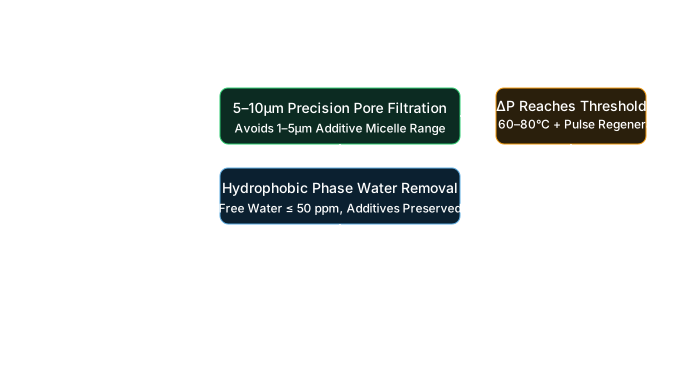
Scientific pore size selection: the 5–10 μm 'sweet spot' — The Jingyuan JY-DX40-L filling line terminal fine filtration system adopts 5–10 μm nominal precision (βₓ ≥ 200, ISO 16889), deliberately avoiding the 1–5 μm additive micelle range. This effectively intercepts wear particles and sludge above 5 μm while completely preserving key additives such as detergents/dispersants.
Stability of rigid pore walls — Unlike the soft fibers of traditional glass fiber cartridges, Jingyuan rigid membranes feature self-supporting sintered pore walls that do not deform under 0.6 MPa working pressure and 80°C oil temperature. This ensures absolutely stable filtration precision and avoids secondary contamination from 'unloading effects.'
Hydrophobic phase separation: physical dewatering without removing additives — The membrane surface is modified to be lipophilic and hydrophobic, physically repelling and coalescing water molecules to control free water at ≤ 50 ppm while completely unaffected oil-soluble additives. Compared to chemical dehydrants (which may alter oil chemical properties), physical separation is safer and more reliable.
Gas-pulse regeneration: self-recovery in hot oil environments — When trans-membrane pressure differential reaches the threshold, the system automatically triggers N₂/compressed air pulse backwashing, with the entire process taking 5-15 min safety pause with brief 5-15 min safety pause. Post-regeneration flux recovery is ≥ 90%. For high-viscosity oils, the system supports heating to 60–80°C to reduce viscosity before backwashing, ensuring regeneration effectiveness.
Lubricating Oil Filtration Solution Comparison: Traditional Cartridge vs. Jingyuan Rigid Membrane
| Comparison Dimension | Traditional Disposable Cartridge | Jingyuan Rigid Membrane |
|---|---|---|
| Filtration precision | 3–25 μm (nominal, large actual fluctuation) | 5–10 μm nominal precision, βₓ ≥ 200 |
| Additive protection | 3–5 μm cartridges trap micelles | 5–10 μm deliberately avoids micelle range |
| High viscosity adaptability | High differential pressure, rapid flow decay | Rigid pore walls, stable differential pressure |
| Regeneration method | Shutdown and replacement | Online gas-pulse backwash, 5-15 min safety pause |
| Hot oil operation stability | Fibers may soften and shed | Sintered structure, ≥ 120°C temperature resistance |
| Consumables cost | Continuously generated | ≈ 0 within 3 years |
| Hazardous waste treatment | HW08 spent cartridges | No spent cartridges generated |
From blending to filling, JY-DX40-L achieves fine filtration and additive protection at the terminal stage
Jingyuan Lubricating Oil Filtration Product Selection
For different lubricating oil application scenarios, Jingyuan offers a full range of filtration equipment from filling lines to industrial sites:
JY-DX40-L · Filling Line Terminal Fine Filtration System
Applicable:Lubricating oil filling line terminal, blending line outlet, outgoing quality assurance
Highlights:Scientific pore size protects 1–5 μm additive micelles; over 18 months of continuous core-free production records; outgoing mechanical impurities ≤ 0.005%
JY-H330 · Industrial Lubricating Oil Purification Fine Filtration Unit
Applicable:Lubricating oil refining, intermediate process filtration, regeneration utilization, hydraulic station bypass purification
Highlights:Skid-mounted design, ≥ 3 years membrane module life; gas-pulse regeneration, zero-consumable operation; completely eliminates production interruptions caused by cartridge replacement
JY-H130 · Small Mobile Lubricating Oil Purification Fine Filter
Applicable:Shop floor lubricating oil maintenance, machinery bypass purification, small-batch oil change assistance
Highlights:Compact mobile design, easy to operate; zero-consumable operation; suitable for multi-equipment rounds
JY-G100 · Mobile Oil Purification System
Applicable:Hydraulic oil, gear oil, cutting fluid on-site purification; multi-viscosity oil adaptation
Highlights:5,000 Gs magnetic pre-filtration + rigid membrane dual-stage; viscosity-adaptive flow rate (10–60 L/min); gas-pulse/solvent cleaning dual-mode regeneration
Customer Cases: From Filling Lines to Industrial Sites
Jingyuan lubricating oil filtration systems have been validated in lubricant production and industrial maintenance scenarios:
Southern Africa Large Industry and Mining Supporting Enterprise
Challenge:Multi-viscosity oil (VG 32–220) management difficulties; mine dust contamination leading to ISO 22/20/17; traditional cartridges prone to pressure buildup in multi-purpose machine scenarios
Solution:JY-G100 mobile industrial oil purification system, viscosity-adaptive flow rate + multi-stage fine filtration
Result:Cleanliness significantly improved; proportional valve seizure incidents reduced; oil change and maintenance cost savings within one year covered equipment investment
A Re-refining Plant for Environmental Lubricants
Challenge:Waste lubricating oil vacuum distillation distillate contains large amounts of oxidized polymers, carbon black, and gum; traditional filtration extremely prone to membrane blinding
Solution:JY-DCF7 rotary membrane filter, dynamic shear force suppresses gel layer formation
Result:Gum removal rate approximately 90%; flux stability approximately 3 times higher than static membrane; energy consumption approximately 40% lower than centrifuge
Frequently Asked Questions about Lubricating Oil Filtration
Can 5–10 μm filtration precision effectively protect hydraulic servo valves?
Yes. Servo valve typical clearances are 5–15 μm; 5–10 μm nominal precision (βₓ ≥ 200) effectively intercepts particles that cause valve spool seizure. At the same time, the 5–10 μm pore size deliberately avoids the 1–5 μm additive micelle range, achieving a balance of 'removing impurities while protecting additives.'
Will flow rate decrease when filtering high-viscosity gear oil (VG 220 and above)?
The pressure differential of rigid membranes mainly comes from channel resistance rather than filter cake buildup, so although the initial differential pressure under high viscosity is higher than for low-viscosity oils, differential pressure growth is slow. For high-viscosity oils such as VG 680, it is recommended to preheat the oil temperature to 60–80°C before filtration, which can reduce viscosity by 50–70% and significantly improve flow.
Is gas-pulse regeneration effective on hot oil?
Yes. The principle of gas-pulse regeneration is to use the instantaneous impact force generated by gas expansion to strip away the pollution layer on the membrane surface, with little relation to oil viscosity. For high-viscosity oils, it is recommended to raise oil temperature to 60–80°C before regeneration, reduce viscosity, and then backwash for better regeneration results.
Are rigid membranes suitable for both synthetic lubricants and mineral oils?
Yes. Jingyuan rigid membrane materials are polymer-based, with good chemical stability for mineral oils, synthetic hydrocarbons (PAO), ester oils, and polyether oils. Temperature range −20°C to 120°C, covering the vast majority of industrial lubricant operating conditions.
After using JY-DX40-L on the filling line, is a terminal cartridge still needed?
No. The 5–10 μm nominal precision of JY-DX40-L already meets the terminal filtration requirements of the vast majority of lubricating oil filling lines, with outgoing mechanical impurities ≤ 0.005% (GB/T 511). Actual operating records show continuous operation for over 18 months without cartridge replacement, directly replacing traditional terminal cartridges.
Download Technical Documents
Download PDF materials for product selection, technology briefs, and industry application guides.
PDF download requires email registration. Your information will be used only to send you the guide and related technical updates.
Need help selecting the right filtration system for your application?
Discuss Your Application →