Unique Challenges of Mining Diesel Filtration: Why Conventional Solutions Fail at Mine Sites
Mining operations impose far more stringent requirements on diesel fuel quality than typical industrial settings. The combination of open-pit dust, tropical heat and humidity in regions like Indonesia, poor-quality fuel in remote areas, and the widespread adoption of High-Pressure Common Rail (HPCR) injection systems in modern mining equipment creates a uniquely complex diesel management landscape.
HPCR systems are extremely sensitive to cleanliness. Modern mining trucks, excavators, and generator sets feature HPCR injector nozzle clearances of only 2–5 μm. Hard particles in diesel (such as mineral dust and iron oxide rust) cause abrasive wear on injector components, resulting in uneven spray patterns, incomplete combustion, and power loss. A single injector replacement costs RMB 3,000–15,000, while a large mining truck typically carries 6–12 injectors.
The mining environment intensifies contamination. Open-pit dust contains large amounts of quartz sand and hard mineral powder, with particle sizes of 5–50 μm, which easily enter the fuel system through tank breather vents, fill ports, and transfer operations. Biodiesel blends (B35/B40) in tropical mining regions like Indonesia are more prone to microbial growth due to humidity and temperature, forming "fuel sludge" that clogs fuel lines.
Remote locations magnify maintenance difficulties. Mines in Africa, South America, and Southeast Asia are often hundreds of kilometers from the nearest city, with filter consumables logistics cycles of 2–8 weeks. Once filters are exhausted and equipment shuts down, direct losses can reach tens of thousands of RMB per day.
Characteristics and Hazards of Mining Diesel Contaminants
| Contaminant Type | Primary Source | Typical Particle Size | Hazard to HPCR Systems |
|---|---|---|---|
| Quartz mineral dust | Dust, loading operations | 10–100 μm | Abrasive wear of injectors, clogging of high-pressure pumps |
| Iron oxide rust | Aging pipelines, storage tanks | 5–50 μm | Erosion of precision components, reduced sealing |
| Biodiesel gum | B35/B40 oxidation and polymerization | Colloidal | Clogging of screens, formation of lacquer deposits |
| Microbes / fuel sludge | Humid environment + free water | Colloidal | Clogging of fuel lines, acid production corroding tanks |
| Sand and dust particles | Open refueling, tank breathing | 20–200 μm | Wear of fuel pumps, clogging of coarse filters |
Graded Filtration Strategy: Three Lines of Defense from Fuel Depot to Tank
Mining diesel filtration cannot rely on a single device; instead, a multi-level protection system from the fuel depot to the equipment tank must be established. Jingyuan's recommended mining filtration strategy consists of three lines of defense:
First line: Centralized depot purification (high flow) — Install high-flow purification equipment (such as the JY-DX40, 40 m³/h) at the outlet of the main mine storage tank to pre-purify all outgoing diesel. This step removes more than 90% of large particles and free water, improving cleanliness from ISO 24/22/19 to ISO 15/13/10.
Second line: Refueling truck / point terminal fine filtration (medium flow) — Configure mobile fine filtration equipment (such as the JY-G100, 10–60 L/min) at refueling trucks or fixed refueling points for a final fine filtration of diesel before it enters the equipment tank. This step removes remaining fine particles, further improving cleanliness to ISO 12/9/6.
Third line: Onboard / equipment-level online protection (low flow) — For critical equipment (such as large mining trucks and generator sets), an onboard fine filter (such as the JY-210, ≤10 L/min) can be installed in series in the fuel line as the final barrier before the engine. This step effectively intercepts secondary contamination that may be introduced during refueling.
The core advantage of the three-level coordinated approach is: high-flow equipment handles "volume," mobile equipment handles "quality," and onboard equipment handles "the last line of defense." The overall solution can extend injector life by 2–4 times and engine overhaul intervals by 30–50%.
Cost Comparison of Mining Diesel Filtration Strategies: Single-Stage vs. Graded
| Cost Item | No Filtration / Single-Stage Coarse Filtration | Jingyuan Three-Stage Graded Filtration |
|---|---|---|
| Initial equipment investment | RMB 0–50,000 | RMB 150,000–300,000 |
| Annual injector replacement cost | RMB 80,000–200,000 | RMB 10,000–30,000 |
| Annual engine maintenance cost | RMB 150,000–400,000 | RMB 50,000–120,000 |
| Downtime loss (unplanned) | RMB 200,000–500,000/year | RMB 30,000–80,000/year |
| Annual filter logistics cost (remote) | RMB 20,000–50,000 | ≈ 0 (no consumables) |
| 3-year total cost | Approx. RMB 1.3–3.5 million | Approx. RMB 350,000–750,000 |
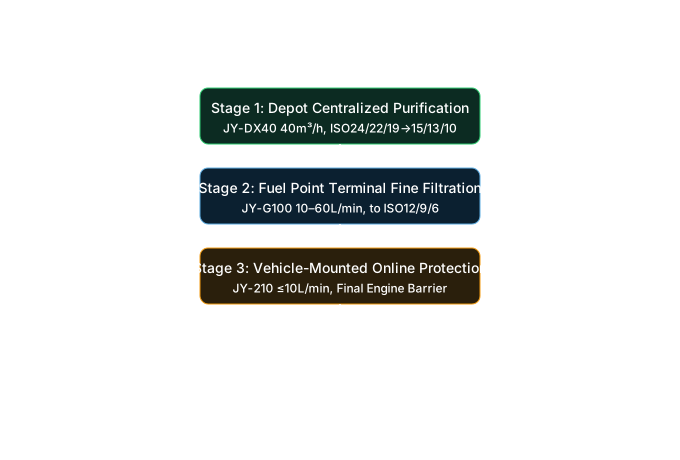
From the main mine fuel depot to the equipment tank, three lines of defense ensure diesel cleanliness
Jingyuan Mining Diesel Filtration Product Selection
For different mining scenarios and equipment scales, Jingyuan offers a full range of filtration equipment from fuel depot to tank:
JY-DX40 · Skid-Mounted Membrane Separation Fine Filtration System
Applicable:Mine main fuel depot centralized purification, gas station supply end
Highlights:8 membrane modules, gas-pulse (5-15 min safety pause) backwash; skid-mounted design for easy mine site deployment; low-temperature resistant version available
JY-G100 · Mobile Oil Purification System
Applicable:Mine fleet refueling points, field temporary fuel depots, construction machinery on-site refueling
Highlights:Hand-push mobile design, 5,000 Gs magnetic pre-filtration + rigid membrane dual-stage; gas-pulse regeneration, no consumables; suitable for high-dust environments
JY-219A · Portable Diesel Purification Refueling Unit
Applicable:Light mining trucks, generator sets, remote stations
Highlights:Portable and mobile, easy to operate; suitable for distributed multi-point deployment; reverse flush regeneration
JY-210 · Onboard Terminal Fine Filter
Applicable:Large mining trucks, generator set fuel line online protection
Highlights:17 high-density rigid membrane arrays; vehicle chassis integration; eliminates secondary contamination from transport to site
JY-T32A · Active Diesel Precision Purification System
Applicable:Medium and small construction machinery, mobile equipment fuel purification
Highlights:Pipeline integrated online installation, no production line shutdown; cart / skid design for flexible movement between sections
Customer Cases: From the Heart of Africa to the Indonesian Rainforest
Jingyuan mining diesel filtration systems have been validated in multiple extreme environments worldwide:
Africa Mining Generator Sets and Heavy Trucks
Challenge:Severe local diesel particulate contamination (ISO 24/22/19), frequent injector clogging; extremely high spare parts logistics costs due to remote location
Solution:Multiple sets of 12 m³/h Jingyuan diesel filtration skid-mounted equipment, deployed at main storage tanks and fuel island front ends
Result:Cleanliness improved to ISO 12/9/6; unplanned injector replacement rate significantly reduced; fuel filter life effectively extended; ensured continuous mining operations
West Africa Large Infrastructure Contractor Fleet
Challenge:Over 200 excavators and bulldozers; local diesel high in sand content; HPCR systems sensitive; frequent downtime causing construction delays
Solution:Multiple JY-G100 mobile filters, "refueling equals purification" mandatory standard
Result:Engine "black smoke" and power deficiency significantly reduced; average annual fuel system maintenance costs significantly lowered; became standard equipment at all project sites
Indonesia Open-Pit Coal Mine
Challenge:B35 biodiesel poor stability, prone to "fuel sludge"; extreme dust environment; mining trucks frequently underpowered, injectors seized
Solution:Multiple JY-DX40 high-flow purification systems, operating in parallel to meet ultra-large capacity fuel depot needs
Result:Cleanliness stabilized at ISO 15/13/10; injector life effectively extended; engine combustion more complete, single-unit fuel consumption reduced
Frequently Asked Questions about Mining Diesel Filtration
What special requirements does biodiesel (B35/B40) have for rigid membranes?
Biodiesel has higher gum content and oxidation sensitivity than pure diesel, placing greater demands on membrane anti-fouling capability. Jingyuan rigid membranes' hydrophobic surface effectively inhibits microbial growth in biodiesel, and gas-pulse regeneration also provides good recovery from gum clogging. Field measurements in Indonesian mines show that JY-DX40 regeneration intervals when processing B35 biodiesel are comparable to those for pure diesel.
In high-dust environments, do membrane elements clog quickly?
High-dust environments do accelerate membrane surface fouling, but Jingyuan's graded filtration strategy is specifically designed for this. The JY-DX40 high-flow depot purification bears more than 90% of the dust removal load, while the JY-G100 terminal fine filtration only handles remaining fine particles. Field data shows that in African high-dust mines, membrane element regeneration intervals can still be maintained at 7–14 days.
Remote mines without nitrogen supply—how is gas-pulse regeneration achieved?
For remote sites without N₂ supply, compressed air can be used as an alternative (a drying and filtration device must be equipped to prevent moisture from entering the system). In addition, JY-G100 and JY-219A support disassembly cleaning and solvent cleaning as backup regeneration methods. It is recommended to confirm on-site gas source conditions during the solution design phase.
Can skid-mounted equipment withstand severe vibration in mining equipment?
Jingyuan skid-mounted equipment uses steel-structure bases and anti-vibration design, capable of withstanding general industrial vibration. For extreme vibration environments (such as near blasting zones), it is recommended to add vibration damping pads or concrete foundations. The onboard equipment (JY-210) is specifically designed for vehicle chassis integration and has passed mining road bump tests.
What is the approximate payback period for a three-stage filtration solution?
For a medium-sized mine consuming 5 million liters of diesel annually, the initial investment for a three-stage filtration solution is approximately RMB 200,000–300,000. By reducing injector replacements (saving RMB 50,000–100,000/year), lowering engine maintenance (saving RMB 80,000–150,000/year), and reducing downtime losses (saving RMB 100,000–200,000/year), the investment payback period is typically 8–14 months.
Download Technical Documents
Download PDF materials for product selection, technology briefs, and industry application guides.
PDF download requires email registration. Your information will be used only to send you the guide and related technical updates.
Need help selecting the right filtration system for your application?
Discuss Your Application →