Industrial Filtration Solution Selection: Why 3-Year TCO Gap Can Reach 2–3x
In industrial diesel, lubricating oil, and specialty fluid filtration solution selection, procurement decision-makers typically face two technical routes: traditional disposable cartridges (including glass fiber, melt-blown PP, stainless steel mesh pleated cartridges, etc.) and Jingyuan CIS high-polymer rigid composite membrane filtration systems.
The two solutions differ significantly in initial investment: cartridge systems typically cost RMB 80,000–150,000/unit, while rigid membrane systems cost RMB 250,000–400,000/unit. However, when the time dimension extends to 3-year total cost of ownership (TCO), the conclusion is often surprising — the cartridge solution's 3-year TCO typically exceeds the rigid membrane solution by 20–60%.
This article systematically compares from four dimensions: filtration principle, operating cost, maintenance mode, and environmental compliance, helping engineers and procurement decision-makers make data-based judgments.
Filtration Principle and Performance Comparison
| Comparison Dimension | Disposable Cartridge | Jingyuan Rigid Composite Membrane |
|---|---|---|
| Filtration Mechanism | Depth/surface physical interception, replacement required when dust-holding capacity saturated | Self-supporting rigid pore wall, asymmetric gradient micropore depth filtration |
| high-efficiency capture Ratio | β₁₀ = 2–20 (ISO 16889) | βₓ ≥ 200 (ISO 16889) |
| Retention Efficiency | 50–95% (decreases with use time) | ≥ 99.5% (stable and constant) |
| Pore Size Stability | Soft fibers deform under pressure, pore size increases | Rigid pore wall unaffected by pressure fluctuation, absolute pore size constant |
| Dehydration Capability | Requires additional coalescing cartridge or demulsifier | Membrane surface hydrophobic modification, physically repels free water ≤ 50 ppm |
| Anti-Fouling Capability | Easily clogged, limited dust-holding capacity | High dirt-holding capacity, gas-pulse regeneration restores flux ≥ 90% |
Operating Cost Comparison: The Essential Difference Between Consumables and Non-Consumables
The cartridge solution's largest hidden cost comes from continuous consumable procurement. Taking a medium-sized tank farm single loading filter as an example:
Cartridge Replacement Frequency — Depending on oil quality and flow rate, replacing 2–4 cartridges per month is normal. Each cartridge costs RMB 800–2,500, with annual consumable costs of RMB 30,000–80,000. Three-year cumulative consumable costs of RMB 90,000–240,000 typically exceed equipment cost by 2–3 times.
Rigid Membrane Non-Consumable Structure — Jingyuan rigid membrane elements adopt self-supporting sintered structure, with no fiber shedding risk and no consumable consumption. Under normal operating conditions, membrane element life ≥ 3 years. Gas-pulse regeneration replaces physical replacement, with single regeneration taking 5-15 min safety pause and N₂ consumption ≤ 0.5 kg, cost negligible.
Used Cartridge Disposal Cost — Replaced cartridges are classified as oil-containing hazardous waste (HW08), requiring qualified unit treatment. Treatment cost is RMB 3,000–8,000 per ton, with medium tank farms generating 0.5–2 tons of used cartridges annually, 3-year disposal costs of RMB 45,000–120,000. The rigid membrane solution completely eliminates this cost item.
3-Year Total Cost of Ownership (TCO) Detailed Comparison
| Cost Item | Disposable Cartridge Solution | Jingyuan Rigid Membrane Solution |
|---|---|---|
| Initial Equipment Investment | RMB 80,000–150,000/unit | RMB 250,000–400,000/unit |
| 3-Year Consumable Cost | RMB 90,000–240,000 | ≈ 0 |
| Downtime Maintenance Time | 18–72 hours/year | < 1 hour/year |
| Used Cartridge Hazardous Waste Treatment | RMB 45,000–120,000/3 years | ≈ 0 |
| Labor Cost (Replacement) | RMB 20,000–50,000/3 years | ≈ 0 |
| 3-Year TCO Total | Approx. RMB 250,000–550,000 | Approx. RMB 280,000–420,000 |
| Annual Cost from Year 4 | Continued RMB 30,000–80,000/year | Only inspection fees < RMB 5,000/year |
| 5-Year TCO Forecast | Approx. RMB 350,000–750,000 | Approx. RMB 300,000–450,000 |
Maintenance Mode Comparison: Cartridge Replacement vs. Regeneration with Safety Pause
Maintenance mode directly impacts production continuity and labor input.
Cartridge Solution: Passive Reactive Maintenance — Operators need to regularly check differential pressure gauges, shutdown for cartridge replacement when differential pressure reaches threshold. Each replacement involves: shutdown → depressurization → cover removal → extract old cartridge → install new cartridge → reset → pressure test → resume operation. Entire process 30–120 minutes, requiring 1–2 technicians. During tank farm peak periods or continuous production lines, shutdown windows are extremely difficult to coordinate.
Rigid Membrane Solution: Predictive Online Maintenance — The system automatically monitors trans-membrane differential pressure, automatically triggering gas-pulse regeneration when threshold is reached. Entire process 5-15 min safety pause, no manual intervention, brief 5-15 min safety pause. Operators only need periodic inspections (recommended monthly), checking differential pressure trends and instrument status.
Labor Input Difference — Cartridge solution requires 12–24 replacement operations per year, cumulative labor input 24–48 hours. Rigid membrane solution requires only 12 inspections per year, 15–30 minutes each, cumulative 3–6 hours. For remote sites or labor-constrained factories, this difference is particularly critical.
Application Scenario Analysis: When to Choose Rigid Membrane, When to Choose Cartridge
The two technologies are not absolute substitutes, but optimized choices for different scenarios.
Selection Decision Reference
| Scenario Characteristics | Recommended Solution | Reason |
|---|---|---|
| Annual operating time > 6000 hours, high downtime cost | Rigid Membrane | Regeneration avoids downtime loss, 3-year TCO superior |
| Flow rate > 20 m³/h, continuous operation | Rigid Membrane | Under high flow, cartridge replacement frequency too high, maintenance burden heavy |
| Free water control requirement ≤ 50 ppm | Rigid Membrane | Hydrophobic membrane physical separation, no demulsifier required |
| Strict environmental requirements, difficult hazardous waste treatment | Rigid Membrane | Eliminates used cartridge HW08 hazardous waste treatment burden |
| Remote site, scarce technical personnel | Rigid Membrane | Regeneration reduces labor dependence |
| Annual operating time < 2000 hours, intermittent operation | Cartridge | Low initial investment, long cartridge life under intermittent use |
| Flow rate < 5 m³/h, test/temporary use | Cartridge | Long payback period, cartridges more flexible |
| Extremely limited budget, short-term project | Cartridge | Low initial investment threshold, suitable for short-term trial |
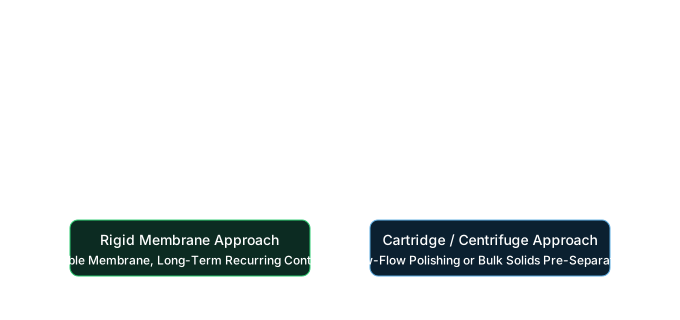
Evaluate operating requirements → assess contamination characteristics and operational constraints → choose rigid membrane if three characteristics are met, choose cartridge/centrifuge for simple scenarios
Technical Boundaries: Rigid Membrane Is Not a Universal Solution
It needs to be honestly stated that rigid membrane technology is not suitable for all scenarios. Understanding its boundaries helps avoid selection mistakes.
Not Suitable for High Solids-Content Fluids — When fluid solids content > 5% (mass fraction), rigid membrane regeneration frequency increases significantly, affecting economics. For such scenarios, centrifugal separation or sedimentation pre-treatment is recommended first, followed by rigid membrane precision filtration.
Not Suitable for Strongly Corrosive Media — When pH < 3 or pH > 11, high-polymer membrane materials undergo chemical degradation. For such scenarios, special alloy cartridges or other corrosion-resistant materials are required.
Initial Investment Threshold — Rigid membrane solution initial investment is 2–3 times that of cartridge solutions. For intermittent application scenarios with annual operating time < 2000 hours, payback period may exceed 3 years.
Membrane Element Expiration Replacement — Although membrane element life ≥ 3 years, membrane module replacement is still required upon expiration (cost approximately 15–25% of total machine price). This cost should be included in long-term budget during selection.
Rigid Membrane vs. Cartridge Frequently Asked Questions
Rigid membrane initial investment is 2–3 times higher than cartridges. How long to recover the cost?
Payback period depends on operating time and flow rate. For a tank farm operating 6000 hours/year at 40 m³/h, cartridge annual consumable cost is approximately RMB 60,000, while rigid membrane annual consumable cost ≈ 0. The extra RMB 150,000–250,000 invested in rigid membrane is typically recovered through consumable savings within 2.5–4 years. The longer the operating time and the larger the flow rate, the shorter the payback period.
Does the rigid membrane affect additives in lubricating oil?
Jingyuan rigid membranes have an absolute pore size ≥ 2 μm, while lubricating oil additive molecules (such as detergents, dispersants, antioxidants) are nanometer scale (< 0.1 μm). Therefore, rigid membranes do not retain additive components. Third-party testing confirms no significant change in key physicochemical indicators (cetane number, acid number, flash point, viscosity) before and after purification.
If a membrane element is accidentally damaged, how long does repair take?
Membrane elements adopt modular design, with single module replacement time of approximately 30–60 minutes. The complete machine is equipped with multiple membrane modules operating in parallel; single module failure does not cause complete machine shutdown, the system can automatically switch to standby modules to continue operation, replacing uniformly during maintenance windows.
Can existing cartridge systems be upgraded to rigid membrane systems?
Direct replacement is possible. Jingyuan equipment adopts standard flange interfaces (GB/T 9119 or ANSI B16.5), pipe diameter DN80–DN150, and can be directly connected to existing pipelines. During retrofit, only confirmation is needed: ① pipe diameter matching; ② reserved power supply (380V/220V); ③ reserved gas source (N₂, 0.5–0.7 MPa). Retrofit shutdown time is typically 4–8 hours.
Is the nitrogen cost for gas-pulse regeneration high?
Single regeneration N₂ consumption ≤ 0.5 kg, at industrial N₂ price of RMB 5–10/kg, single cost is RMB 2.5–5. Regeneration intervals are typically 7–15 days, annual regeneration cost approximately RMB 100–300, negligible compared to cartridge annual consumable costs (RMB 30,000–80,000).
Download Technical Documents
Download PDF materials for product selection, technology briefs, and industry application guides.
PDF download requires email registration. Your information will be used only to send you the guide and related technical updates.
Need help selecting the right filtration system for your application?
Discuss Your Application →