The Technical Bottleneck of Waste Oil Regeneration: Why Pre-Treatment Determines Final Quality
China produces approximately 6–8 million tons of waste mineral oil annually, of which only about 30–40% is effectively regenerated and utilized. The remainder is either inefficiently incinerated or enters informal processing channels. The core bottleneck restricting waste oil regeneration rates is not the back-end distillation or hydrogenation processes, but the filtration efficiency of the front-end pre-treatment stage.
Waste oil composition is extremely complex. Recycled waste lubricating oil typically contains: metal wear particles (iron, copper, aluminum, 5–500 μm), oxidized polymers and gum (colloidal–10 μm), carbon black and soot (0.5–5 μm), water (100–5000 ppm), and various additive decomposition products. These contaminants interweave with each other, forming high-viscosity 'sludge' mixtures that pose severe challenges to traditional filtration equipment.
Insufficient pre-treatment causes downstream chain losses. When hard particles and gum in waste oil enter the vacuum distillation tower without effective removal, it causes frequent coking at the tower bottom, heat exchanger clogging, and catalyst poisoning, ultimately leading to: rectification tower maintenance cycles shortened by more than 50%, catalyst replacement costs increased by 2–3 times, and regenerated base oil color exceeding standards (ASTM D1500 > 5.0), making it difficult to enter the high-end lubricant blending market.
Environmental regulations are becoming increasingly stringent. Since 2024, multiple provinces in China have included waste oil regeneration in the key environmental supervision catalog, requiring regeneration enterprises to achieve 'reduction, resource recovery, and harmlessness.' Waste oil regeneration enterprises without sufficient pre-treatment face dual pressure from environmental compliance risks and market access thresholds.
Typical Waste Oil Contaminant Characteristics and Pre-Treatment Requirements
| Contaminant Type | Primary Source | Typical Particle Size / Concentration | Impact on Regeneration Process |
|---|---|---|---|
| Metal wear particles | Engines, gearboxes, hydraulic pumps | 5–500 μm | Wear of distillation tower internals, heat exchanger clogging |
| Oxidized gum / sludge | High-temperature oxidation, additive decomposition | Colloidal–50 μm | Clogging of fine filters, catalyst contamination |
| Carbon black / soot | Incomplete combustion, thermal pyrolysis | 0.5–10 μm | Increased residual carbon, affecting color index |
| Free water | Condensation, cleaning residue | 500–5000 ppm | Causing distillation boil-over, accelerating equipment corrosion |
| Additive residues | Antioxidant, detergent/dispersant degradation | Molecular–colloidal | Interfering with subsequent hydrogenation reactions |
Pain Points of Traditional Pre-Treatment Technology: Why Centrifuges and Plate Filters Struggle to Perform
The waste oil regeneration industry has long used centrifugal separation, plate-and-frame filtration, and vacuum dehydration as pre-treatment methods. The limitations of these technologies in handling waste oil are becoming increasingly apparent.
Centrifuge: separation fails when densities are close — The principle of centrifugal separation is to use density differences to achieve solid-liquid separation. However, the density of gum in waste oil (0.95–1.05 g/cm³) is extremely close to that of base oil (0.85–0.90 g/cm³), with centrifugal separation efficiency typically < 60%. More critically, gum may emulsify under high-speed rotation, actually aggravating downstream contamination.
Plate-and-frame / bag filtration: frequent replacement, cannot operate continuously — Although plate-and-frame and bag filtration have low initial investment, under the high dirt load of waste oil, filter cloth clogging is extremely rapid, with replacement frequency reaching 1–2 times per shift. This not only causes labor costs to surge but also makes continuous production impossible, severely mismatching the rhythm of modern regeneration lines.
Vacuum dehydration: only removes water, not impurities — Vacuum dehydration is effective at removing free water but almost powerless against solid particles and gum. Moreover, vacuum systems have high energy consumption (typically 5–15 kW/m³), and treatment efficiency for high-viscosity waste oil (viscosity still > 100 cSt at 100°C) is extremely low.
Static membrane filtration: rapid flux decay — Some enterprises have attempted to use traditional cross-flow membrane filtration to treat waste oil, but gum rapidly forms a dense gel layer on the membrane surface, causing flux to drop by 70–90% within hours, with difficult cleaning recovery.
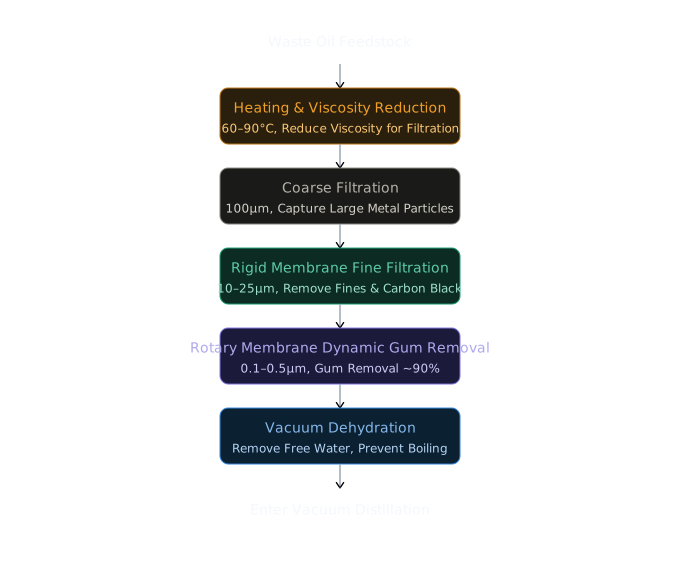
Centrifuge rough separation + rigid membrane fine filtration + rotary membrane de-gumming combined process, comprehensive energy consumption reduced by approximately 40%
Jingyuan Waste Oil Regeneration Pre-Treatment Technology: Rigid Membrane + Dynamic Shear Combination Solution
For the complex conditions of waste oil regeneration, Jingyuan provides two complementary pre-treatment technology routes: rigid membrane fine filtration systems for high-flow solid-liquid separation, and rotary membrane dynamic filtration systems for high-viscosity gum removal.
Rigid membrane fine filtration: high-flow continuous impurity removal — For metal particles, carbon black, and coarse gum in waste oil, Jingyuan's 30 m³/h waste oil dedicated purification unit adopts a multi-stage gradient interception architecture (10–25 μm). The self-supporting pore walls of the rigid membrane are unaffected by high viscosity, maintaining stable flux and differential pressure at 60–80°C operating temperatures. Gas-pulse regeneration replaces frequent filter cloth replacement, achieving true continuous operation.
Rotary membrane dynamic filtration: conquering the gum problem — For waste oil distillates with gum content > 3%, Jingyuan's JY-DCF7 rotary membrane filter uses high-speed rotating membrane discs (500–1500 rpm) to generate dynamic shear force, continuously scouring the membrane surface to effectively suppress gel layer formation. Membrane pore size is 0.1–0.5 μm, precisely intercepting oxidized polymers and gum clumps while allowing base oil molecules to permeate rapidly.
Synergistic process design — A typical waste oil regeneration pre-treatment process is: heating to reduce viscosity (60–90°C) → coarse filtration (100 μm, removing large metal chips) → rigid membrane fine filtration (10–25 μm, removing fine particles and carbon black) → rotary membrane de-gumming (0.1–0.5 μm, removing gum) → vacuum dehydration (removing free water) → entering vacuum distillation. Jingyuan can customize single-stage or multi-stage combination solutions according to customer feedstock characteristics and capacity requirements.
Waste Oil Pre-Treatment Technology Comparison: Traditional Solutions vs. Jingyuan Combination Solution
| Comparison Dimension | Centrifuge + Plate-and-Frame | Jingyuan Rigid Membrane + Rotary Membrane |
|---|---|---|
| Gum removal rate | < 60% | Approximately 90% |
| Treatment flux stability | Greatly affected by feed fluctuations | Stable, rotary membrane flux approximately 3 times higher than static membrane |
| Continuous operation capability | Requires frequent shutdown maintenance | 24/7 continuous operation, regeneration |
| Consumables cost | Continuous consumption of filter cloth/bags | ≈ 0 within 3 years |
| Energy consumption | High (centrifuge 5–20 kW) | Approximately 40% lower than centrifuge |
| Downstream catalyst protection | Limited effect | Rectification tower maintenance cycle extended by approximately 50% |
| Regenerated oil color | ASTM D1500 > 5.0 | ASTM D1500 ≤ 2.0–3.0 |
Jingyuan Waste Oil Regeneration Pre-Treatment Product Selection
For different waste oil feedstocks and regeneration process requirements, Jingyuan offers a full range of pre-treatment equipment from coarse filtration to fine gum removal:
30m³/h waste oil dedicated purification unit · Large-flow waste oil front-end purification system
Applicable:Waste lubricating oil centralized collection stations, regeneration plant pre-treatment lines
Highlights:Multi-stage solid-phase separation, continuous operation under high dirt load; 316L stainless steel corrosion and wear resistant; differential pressure alarm + automatic backwash; sludge reduction, lowering hazardous waste disposal costs
JY-DCF7 · Rotary membrane filter (dynamic de-gumming)
Applicable:Waste oil vacuum distillation pre-de-gumming, lubricating oil refining, high-viscosity gum separation
Highlights:Dynamic shear force suppresses gel layer formation; polymer rigid composite membrane, temperature resistant 120°C; online CIP in-place cleaning; concentrate (containing gum) compliant collection
JY-G100 · Mobile oil purification system
Applicable:Decentralized waste oil collection points, shop floor pre-treatment, small-batch waste oil purification
Highlights:5,000 Gs magnetic pre-filtration + rigid membrane dual-stage; mobile design, flexible deployment; gas-pulse/solvent cleaning dual-mode regeneration
Customer Cases: From Waste Oil Recovery to High-Quality Regenerated Base Oil
Jingyuan waste oil regeneration pre-treatment systems have been validated at multiple domestic regeneration enterprises and environmental projects:
Southwest China waste lubricating oil environmental treatment enterprise
Challenge:Waste oil composition complex (metal chips, oxidized resin, gum), direct entry into regeneration process causes frequent rectification tower clogging; regenerated oil color poor, difficult to meet high-end blending requirements
Solution:30 m³/h waste oil dedicated purification unit, multi-stage gradient interception + sludge reduction
Result:Particle contamination reduced from >24/22/19 to ≤20/18/15; rectification tower maintenance cycle extended by approximately 50%; regenerated base oil color meets standards, entering high-end lubricant blending market
Environmental lubricant re-refining plant
Challenge:Vacuum distillation distillate contains large amounts of oxidized polymers, carbon black, and gum; traditional filtration extremely prone to membrane blinding; centrifuge high energy consumption, frequent maintenance
Solution:JY-DCF7 rotary membrane filter, dynamic shear force suppresses gel layer formation
Result:Gum removal rate approximately 90%; flux stability approximately 3 times higher than static membrane; energy consumption approximately 40% lower than centrifuge; regenerated base oil residual carbon and gum indicators reduced by 80–90%
Southwest China waste mineral oil regeneration utilization enterprise
Challenge:Mine waste oil high in mud and metal chips; heat exchanger frequent scaling; distillation efficiency low; regenerated oil grade limited
Solution:30 m³/h waste oil dedicated process purification unit, high-viscosity adaptation + multi-stage gradient filtration
Result:Distillation efficiency significantly improved; final output purity at a good level in the region; resource recovery efficiency improved, meeting environmental supervision requirements
Frequently Asked Questions about Waste Oil Regeneration Pre-Treatment
Why is gum in waste oil particularly difficult to treat?
Gum is a long-chain polymer generated during high-temperature oxidation and additive decomposition of lubricating oil, with strong adhesion and colloidal characteristics. Its density is close to that of base oil (0.95–1.05 g/cm³), making traditional centrifugal separation ineffective; and gum easily forms a dense gel layer on the filtration membrane surface, causing static membrane filtration flux to drop sharply. Jingyuan rotary membrane technology uses dynamic shear force to continuously scour the membrane surface, effectively suppressing gel layer formation, thereby maintaining stable high flux.
Can pre-treated waste oil be directly used for blending new lubricants?
Pre-treated waste oil still needs to go through back-end processes such as vacuum distillation (or solvent extraction) and hydrogenation refining to be converted into regenerated base oil. The value of Jingyuan's pre-treatment system lies in: ① removing more than 90% of solid impurities and gum, protecting back-end equipment; ② reducing the residual carbon and color of regenerated base oil, enabling it to meet Group I/II base oil standards, which can be used for blending industrial lubricants and some automotive lubricants.
How is the concentrate (containing gum) produced by rotary membrane filtration handled?
The concentrate is classified as hazardous waste (HW08), and must be entrusted to qualified hazardous waste treatment units for compliant disposal. Jingyuan systems are equipped with concentrate collection tanks, which can concentrate gum to 30–50% solids content, reducing total volume by 60–80%, thereby lowering hazardous waste transportation and disposal costs. Some customers send concentrate to incinerators or cement kiln co-processing.
Do different sources of waste oil (vehicle, industrial, mining) require different pre-treatment solutions?
Yes. Vehicle waste oil typically has higher gum content (3–8%), and it is recommended to adopt a two-stage 'rigid membrane coarse filtration + rotary membrane de-gumming' solution; industrial waste oil (such as hydraulic oil) has more metal particles, and it is recommended to strengthen magnetic pre-filtration and coarse filtration; mining waste oil has high mud content, and it is recommended to add sedimentation pre-treatment. Jingyuan can conduct small-scale test verification based on customer-provided waste oil samples to customize the optimal process route.
What is the approximate payback period for a waste oil pre-treatment system?
For a medium-sized regeneration plant processing 5,000 tons of waste oil annually, the initial investment for a Jingyuan pre-treatment system is approximately RMB 500,000–800,000. By reducing rectification tower maintenance (saving RMB 100,000–200,000/year), extending catalyst life (saving RMB 150,000–300,000/year), and improving regenerated oil quality premium (increasing revenue by RMB 200,000–400,000/year), the investment payback period is typically 12–18 months.
Download Technical Documents
Download PDF materials for product selection, technology briefs, and industry application guides.
PDF download requires email registration. Your information will be used only to send you the guide and related technical updates.
Need help selecting the right filtration system for your application?
Discuss Your Application →